


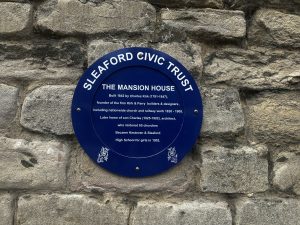
The original Committee decision and aspiration was to place plaques showing historical information on our town bridges, but after some discussion we came up with the idea of also providing blue plaques for notable people who were born in or have been associated with Sleaford and who have made their mark on the town.
With this in mind, and to move on with the Project, we formed a Working Group from four of our Committee Members and also Dr Simon Pawley. At our first meeting, a priority list of the bridges and also the people to be commemorated on the first few plaques we would like to be installed was drawn up. We then met up with the Conservation Officer at North Kesteven District Council, who agreed to have a town walkabout with the members of the Working Group. His knowledge and advice on the best siting for each bridge and relevant building plaque proved to be of great help and I am sure will continue to be invaluable to enable the future implementation of the Project.
Following on from our walkabout, both Simon and John Dale (our Committee colleague and Civic Trust Researcher) produced some appropriate wording for each plaque and a manufacturer was found to produce the appropriate style of plaque for us at a realistic price. We then need to obtain permission from the relevant building owners for installation of a plaque on their property.
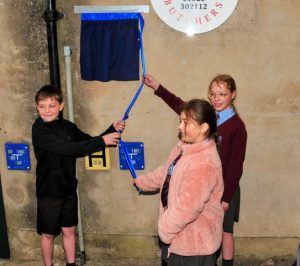
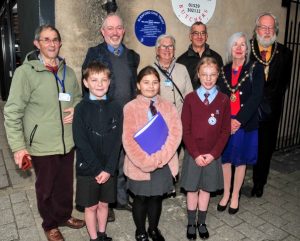
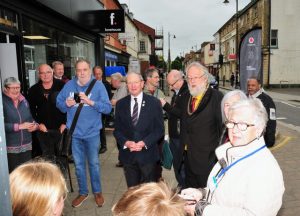
On 14th August 2024, we celebrated with great pride as the first two plaques were erected. You may have noticed that the photograph in the centre above is actually a cake!
John Dale unveiled the first blue plaque at the entrance to Ward and Dale's former yard and workshops at what is now the New Life Church, Mareham Lane. Ward and Dale were the world's largest steam ploughing company, and John Dale is the great grandson of its founder. The beautiful cake helped to celebrate the occasion in a light lunch for Civic Trust members and invited guests.
The second plaque was unveiled by Dr Simon Pawley on the railings above the Nine Foot river bridge next to Riverside Church and is the first of the blue plaques to name bridges in the town.
So watch this space as we hope to give more information of each Plaque as it is placed - two more are planned for later in the year. John also intends to produce a ring binder file containing the plaque details which you will be able to view in Sleaford Museum.
This is an exciting and ongoing project for the Civic Trust. We pride ourselves that we are not only commemorating some of the people who have made their mark on our town, but we are also helping to make residents and visitors alike aware of some of the town history.


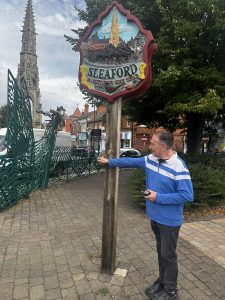
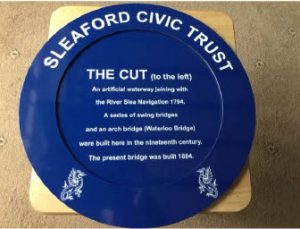
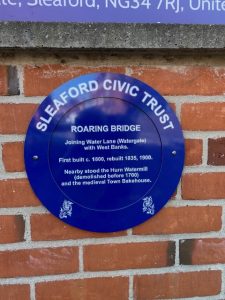
Dr Simon Pawley, who is involved with the Project has written a short history about the history of this area.
It’s difficult now to imagine what Watergate and West Banks looked like before the River Slea was bridged at this point but the first bridge ('Roaring Bridge') was only constructed in around 1800. Before that, Watergate was a dead end. It took you down to the river, but there was no way across to 'The ToQs' (West Banks) beyond. The ToQs were just a series of low-lying fenland closes, mainly used for pasture and probably flooded regularly by the river to their north. Only when the modern streets off West Banks were developed in the years between 1845 and the First World War was the river put into the deep culvert that we see today, in an attempt to control it.
The name Watergate (or Water Lane) is comparatively recent. On the north side of Roaring Bridge Lane, where Riversdale Clinic now stands, was the site of Sleaford’s medieval Common or Town Bakehouse and for centuries the road was known as Bakehouse Lane. Until it disappeared in the middle of the seventeenth century, the Common Bakehouse was where the bakers and other inhabitants of the town were supposed to come in order to use its large communal oven for baking bread. Because of the risk of fires, bakehouses were often placed away from other buildings and (as here) siting it close to a river was a sensible precaution.
Like milling grain, common bakehouses were a manorial monopoly. If you lived in Sleaford, you were supposed to bake only at the common bakehouse and you could be fined for breaking the rules. Behind the back of the old fire station building on the south side of Watergate was the Hurn Mill, one of Sleaford’s five medieval watermills and one of two that stood within yards of each other in the centre of Sleaford. Its companion, the Malt Mill or Town Mill, is commemorated by another Civic Trust blue plaque on Jennings bookmakers, opposite the entrance to Costa Coffee. A 'hurn' is a bend in a road or river, like the one the River Slea takes at this point. Even in the 1550s the Hurn Mill was described as 'in great ruin and decay' and it disappeared completely at some 1me between the two surveys of Sleaford done in 1627 and 1692.
Historic Town Signs
The original wooden town signs which were placed on the entry roads into Sleaford were replaced several years ago. Civic Trust member and local artist, Harriott Brand, offered her skills to renovate and paint the historic town signs to be erected into the refurbished Monument gardens outside Sleaford Museum.
The signs were unveiled at the Grand Re-opening of the gardens on November 16th 2024.


